



Caffeine is the world’s most consumed stimulant, influencing brain function by blocking adenosine receptors that signal fatigue. This boosts neurotransmitters like dopamine and norepinephrine, enhancing alertness, focus, and mood. Research shows:
- Memory: Caffeine improves short-term memory in low-energy times (e.g., mornings) and aids long-term retention when consumed after learning.
- Attention: Small doses (32–40 mg) sharpen focus, while moderate doses (200–300 mg) sustain attention for hours.
- Problem-Solving: Sleep-deprived individuals benefit most, with doses of 300–600 mg restoring logical reasoning.
However, effects vary by dose, task type, and individual factors like genetics and tolerance. While moderate caffeine intake supports mental performance, excessive consumption can lead to side effects like anxiety and reduced accuracy. Pairing caffeine with L-theanine may optimize its effects while minimizing drawbacks.
Using Caffeine to Optimize Mental & Physical Performance
How Caffeine Affects Different Mental Tasks
Caffeine’s influence on mental tasks like memory, attention, and problem-solving shifts based on factors like dosage, task type, and even the time of day. Let’s break down how these effects play out, starting with its role in memory.
Memory: Short-Term and Long-Term Effects
The relationship between caffeine and memory is heavily influenced by timing and context.
A study conducted in November 2016 by researchers at the University of Arizona and Boston College explored caffeine’s effect on short-term memory. Sixty undergraduates, aged 18–21, were tested early in the morning (6:00 a.m.–7:00 a.m.). Those who consumed 180 mg of caffeine showed a 30% improvement in explicit word-stem recall compared to a decaffeinated control group. However, when the same test was repeated in the afternoon (2:00 p.m.–4:00 p.m.), caffeine had no noticeable effect. This suggests caffeine is most beneficial during non-optimal times of day, such as early mornings for young adults or late afternoons for older adults.
"These results suggest that caffeine has a specific benefit for memory during students' non-optimal time of day – early morning." - Lee Ryan, Department of Psychology, University of Arizona
For long-term memory, the timing of caffeine consumption becomes even more critical. A double-blind study at Johns Hopkins University tested this by giving participants a 200 mg caffeine tablet five minutes after studying a set of images. When tested 24 hours later, the caffeine group performed significantly better at "pattern separation", which involves distinguishing original images from similar, but slightly altered, "lure" images.
"Using these items requires the brain to make a more difficult discrimination - what we call pattern separation, which seems to be the process that is enhanced by caffeine in our case." - Michael Yassa, Assistant Professor of Psychological and Brain Sciences, Johns Hopkins University
However, caffeine’s effects aren’t universally positive. A randomized, double-blind study from May 2025 revealed that while 200 mg of caffeine improved object recognition memory, it negatively impacted face recognition. Participants in the caffeine group had a lower "Correct Choice Rate" and a higher "False Alarm Rate" when identifying previously seen faces. This suggests caffeine’s benefits for memory may depend on the type of information being processed.
Attention and Focus
Caffeine delivers consistent benefits when it comes to attention and focus. A meta-analysis of 31 trials revealed measurable improvements in both accuracy (g = 0.27) and reaction time (g = 0.28) following caffeine intake.
Even small amounts - 32 mg to 40 mg - can enhance alertness, vigilance, and reaction time. For tasks requiring sustained attention, moderate doses of around 300 mg can maintain performance for as long as 10 hours.
"The current evidence shows that in the normal population, caffeine acutely enhances attention by improving both reaction time and accuracy." - Kasper Kløve and Anders Petersen, University of Copenhagen
Caffeine shines in tasks measuring executive control, such as the Stroop test. In this test, participants must name the color of a word while ignoring the word itself (e.g., the word "red" printed in blue ink). Caffeine reliably improves reaction times in such scenarios.
However, there’s a limit to its benefits. While reaction speed improves linearly with higher doses, accuracy follows a quadratic pattern - it increases up to a certain point before declining. For tasks requiring both speed and precision, moderate doses around 200 mg are more effective than excessive amounts.
Problem-Solving and Logical Thinking
Caffeine’s ability to enhance problem-solving and logical reasoning depends on the individual’s state of rest.
In well-rested individuals, 200 mg of caffeine showed no significant impact on logical reasoning tasks like the Bochum matrices-advanced test (BOMAT). However, when participants were sleep-deprived, caffeine’s effects became much more pronounced. Doses of 300 mg to 600 mg significantly restored logical reasoning performance for up to 12 hours, bringing it back to levels seen in fully rested individuals. Even a smaller dose of 150 mg provided noticeable improvements for up to 6 hours.
"Caffeine cannot be considered a 'pure' cognitive enhancer. Its indirect action on arousal, mood and concentration contributes in large part to its cognitive enhancing properties." - PubMed
Best Caffeine Doses for Mental Performance
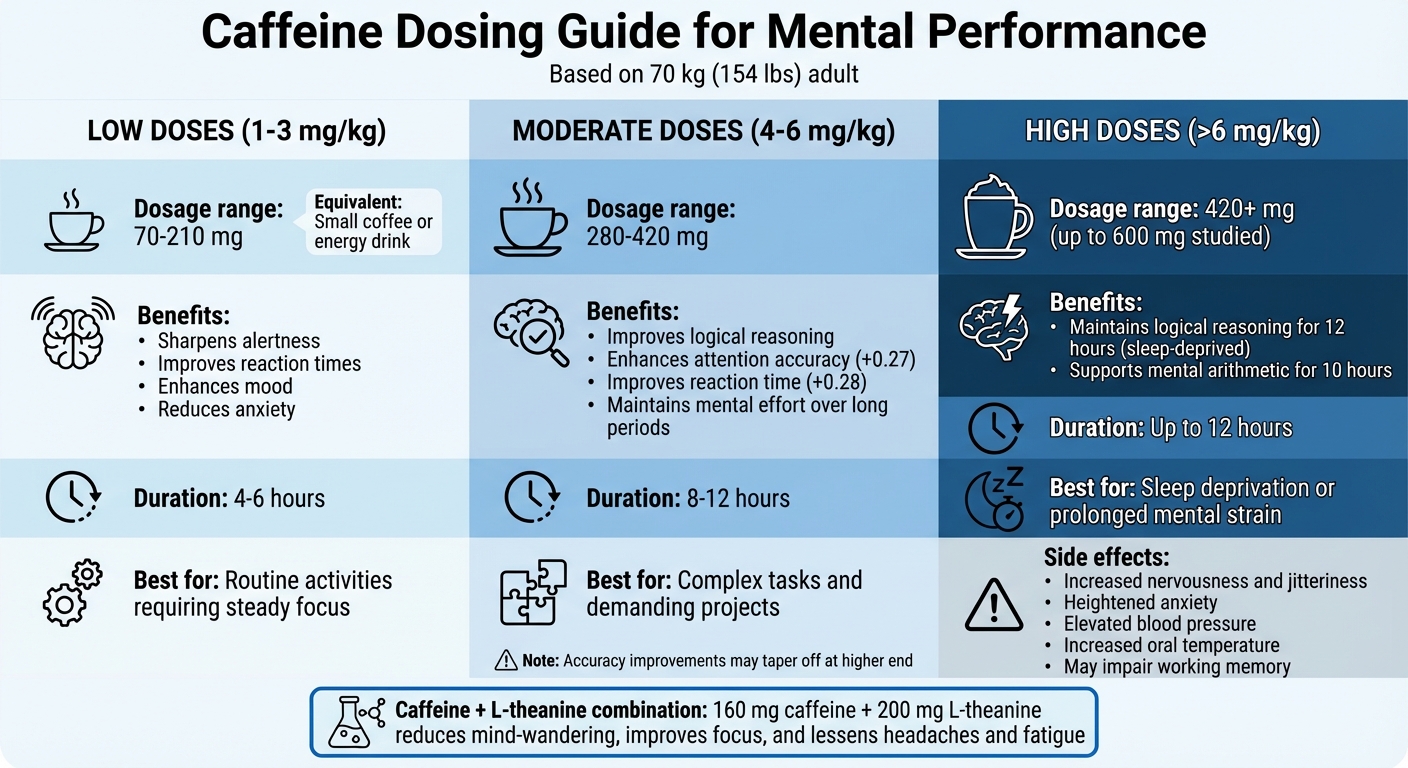
Caffeine Dosage Guide for Cognitive Performance by Body Weight
When it comes to caffeine's effects on the brain, finding the right dose is key to meeting specific mental demands. With its well-documented benefits for memory, attention, and problem-solving, caffeine dosing should align with the task you're tackling.
For an average adult weighing 70 kg (154 lbs), here’s how different caffeine doses stack up:
Low Doses (1–3 mg/kg): Small Boosts for Everyday Tasks
Low doses, ranging from 70 mg to 210 mg (roughly the amount in a small coffee or energy drink), are great for sharpening alertness and improving reaction times. These doses can also enhance mood and reduce anxiety, with effects lasting about 4 to 6 hours. This makes them perfect for routine activities that require steady focus and calm concentration.
Moderate Doses (4–6 mg/kg): Enhanced Attention and Memory
Moderate doses, between 280 mg and 420 mg, take mental performance up a notch. They’re particularly effective for improving logical reasoning, attention accuracy, and maintaining mental effort over long periods. Research shows caffeine in this range can boost accuracy by 0.27 and reaction time by 0.28 in standardized tests. These effects can last 8 to 12 hours, making moderate doses ideal for tackling complex tasks or working through long, demanding projects. However, as intake increases, accuracy improvements may taper off.
High Doses (>6 mg/kg): Handling Stress and Fatigue
High doses - above 420 mg - shine in situations of sleep deprivation or prolonged mental strain. For instance, a dose of 600 mg (about 8.6 mg/kg) has been found to maintain logical reasoning for up to 12 hours and support mental arithmetic for 10 hours in sleep-deprived individuals. However, these doses come with trade-offs. They can significantly increase nervousness, jitteriness, and anxiety. For example, a 6 mg/kg dose was shown to heighten nervousness (P = 0.001) and activeness (P = 0.046) compared to a placebo. Tasks that depend on working memory may also suffer at this level.
"Caffeine's effects are significant primarily when performance of repetitive, nonintellectual tasks is partially degraded." - Institute of Medicine Committee on Military Nutrition Research
High doses can also lead to physiological changes, such as an elevated oral temperature lasting up to 12 hours and increased blood pressure, especially in people who don’t frequently consume caffeine. While these doses can keep you going under stress, the potential side effects and risks should not be overlooked.
sbb-itb-39f6f92
Research Limitations and Mixed Results
While caffeine's positive effects on cognitive tasks have been highlighted, it's important to recognize the limitations and variability in outcomes. Factors like genetics, tolerance, and research methods mean caffeine's impact isn't the same for everyone. These nuances show that the benefits depend heavily on individual and situational circumstances.
How Individual Factors Change Results
Genetics play a significant role in how caffeine affects the brain. For instance, the CYP1A2 gene determines how quickly caffeine is metabolized, dividing people into "fast" and "slow" metabolizers. Another gene, ADORA2A, influences adenosine receptor sensitivity, which can affect how alert or anxious someone feels after consuming caffeine.
A study by Spaeth and Dinges in October 2014 examined 58 men over 88 hours of sleep deprivation. Despite all receiving the same weight-based caffeine dose (0.3 mg/kg), plasma caffeine levels ranged from 2.0 to 9.4 mg/l - a nearly fivefold difference. This highlights how individual biology can dramatically alter caffeine's effects.
Age and sex also play a role. Some research shows cognitive benefits are more pronounced in older adults or certain sexes, with hormones potentially influencing how caffeine impacts memory recall. These findings underscore why caffeine's "optimal dose" varies from person to person.
Regular Use and Reduced Benefits
Frequent caffeine use can limit its cognitive benefits over time. The brain adapts by increasing adenosine A1 receptors and extracellular adenosine, reducing the stimulant's effectiveness. This raises an important question: Does regular caffeine use enhance performance, or just counter withdrawal symptoms like fatigue and sluggishness?
Between July 2016 and December 2018, researchers at the University Hospital of Basel studied 20 healthy men (average age 26.4) who consumed 150 mg of caffeine three times a day for 10 days. Compared to a placebo group, these participants made more errors and had slower reaction times during high-demand memory tasks. Brain scans also showed reduced activity in the right hippocampus, suggesting that daily caffeine use might impair the brain's ability to handle memory-related tasks effectively.
"Our data suggest that such [cerebral metabolic] demands might be impeded over daily intake and therefore result in a worse performance."
– Yu-Shiuan Lin et al., University Hospital Basel
Risks of Too Much Caffeine
Excessive caffeine consumption introduces additional challenges. High doses can cause jitteriness, anxiety, sleep disruptions, and elevated blood pressure, particularly in people who don't consume caffeine regularly. Furthermore, while moderate amounts may improve accuracy, the relationship between caffeine and performance isn't linear. For complex tasks, performance often follows an inverted U-shaped curve, with benefits dropping off once caffeine intake exceeds a certain threshold.
"Caffeine cannot be considered a 'pure' cognitive enhancer. Its indirect action on arousal, mood and concentration contributes in large part to its cognitive enhancing properties."
– Astrid Nehlig, Researcher
In short, both individual differences and tolerance play critical roles in shaping caffeine's benefits and risks.
Conclusion: What the Science Tells Us About Caffeine
Main Points on Caffeine and Mental Performance
Studies show caffeine works by blocking adenosine receptors, which helps improve alertness and focus. A moderate dose - around 200 mg - is often the sweet spot for mental clarity without unpleasant side effects.
The amount of caffeine matters. While reaction time gets better with higher doses, accuracy tends to peak at moderate levels. In cases of extreme sleep deprivation, doses as high as 600 mg can restore logical reasoning for up to 12 hours. However, such high doses may come with downsides like increased tension, jitteriness, and strain on the cardiovascular system.
Interestingly, combining caffeine with L-theanine - a natural compound found in green tea - can fine-tune its effects. For example, pairing 160 mg of caffeine with 200 mg of L-theanine helps reduce mind-wandering, improve focus, and lessen headaches and fatigue. This thoughtful pairing highlights how supplements can enhance caffeine's benefits while cutting down on its drawbacks.
These findings underline caffeine's role in boosting mental performance while emphasizing the importance of proper dosing and smart combinations.
How Purelya Nature Supports Mental Wellness

At Purelya Nature, we know how crucial mental clarity and steady energy are for tackling daily challenges. That’s why our products are crafted with clean, carefully chosen ingredients that support cognitive function naturally - no unnecessary fillers or over-the-top claims. Our goal is to work with your body’s natural rhythms, helping you stay sharp, focused, and balanced throughout the day.
Whether you’re aiming to sustain energy, stay mentally sharp during demanding tasks, or feel more alert without the jitters, Purelya Nature offers solutions rooted in the same science-backed principles discussed here. Visit purelyanature.com to explore how our supplements can help you reach your mental wellness goals.
FAQs
Does caffeine affect memory differently depending on the time of day?
Research indicates that caffeine can boost memory performance, but timing plays a crucial role. For young adults, caffeine seems to be especially helpful in improving memory during early mornings - those groggy, low-energy hours when alertness isn't at its peak. On the other hand, its impact on memory tends to diminish in the afternoon, a time when people are generally more awake and attentive.
This demonstrates that caffeine's influence on cognitive tasks, such as memory, can depend on both the time of day and a person's natural energy levels.
What is the ideal amount of caffeine to boost focus and attention?
Research indicates that consuming low to moderate doses of caffeine - ranging from 40 mg to 300 mg - can help boost focus and attention. For many, sticking to the lower end of this range is enough to sharpen mental clarity without triggering jitteriness or overstimulation.
Since everyone’s tolerance to caffeine is different, it’s a good idea to start with a smaller amount and adjust gradually to find your sweet spot. Be mindful of your intake to avoid side effects like restlessness or trouble sleeping.
Does combining caffeine with L-theanine improve focus and mental performance?
Yes, studies show that combining caffeine with L-theanine can boost focus, mental clarity, and overall cognitive performance. This duo is known to enhance attention and reduce mental fatigue while promoting a calm yet alert state. L-theanine works to smooth out caffeine's stimulating effects, helping you stay concentrated without the jittery side effects that caffeine alone can sometimes cause.
This pairing is especially helpful for tasks that demand prolonged focus, making it a go-to option for those aiming to naturally improve productivity and mental sharpness.