



Your energy levels depend on how and when you expose yourself to light. Timing your light exposure can improve alertness, mood, and sleep quality. Here’s the key takeaway:
- Morning light (within 1 hour of waking) suppresses melatonin, boosts cortisol, and shifts your internal clock earlier.
- Midday light keeps you alert and focused, reducing afternoon sluggishness.
- Evening light (especially blue light) disrupts melatonin and delays sleep.
Simple steps:
- Get 5–15 minutes of natural sunlight in the first hour after waking.
- Use bright indoor lighting if outdoor light isn’t an option.
- Avoid screens and bright lights 2–3 hours before bed.
These small adjustments can help you feel more awake during the day and sleep better at night.
Morning Light Exposure for Peak Energy
Best Time: Within the First Hour of Waking
The first hour after you wake up is the sweet spot for getting light exposure. Why? It helps suppress melatonin (the hormone that makes you sleepy) and boosts cortisol, which gets you alert and ready for the day. Studies show that morning light can even shift your body’s internal clock about one hour earlier each day. And it doesn’t take much - just 5 to 15 minutes of natural sunlight can give your system the jumpstart it needs. If you’re using a light therapy box instead, aim for 30 minutes at around 5,000 lux.
"Getting bright light shortly after waking up may help you feel more alert." - National Institute for Occupational Safety and Health (NIOSH)
Making morning light exposure part of your daily routine can stabilize your internal rhythm and help you shake off that groggy feeling. Consistency is key here - the more regular you are, the better your results.
So, how can you make this part of your morning routine? Let’s break it down.
How to Get Morning Light
Start by stepping outside as soon as you wake up. Even a few minutes on your porch, balcony, or driveway will do the trick. Natural daylight is your internal clock’s best friend. Skip the sunglasses (at least for this brief exposure) so the light can reach the specialized cells in your eyes. You could even enjoy your morning coffee or tea outside to hit that 5 to 15-minute target.
If getting outside isn’t an option, a light therapy box can be a great alternative. Place it about 16 inches (40 cm) from your eyes and turn it on within 5 minutes of waking. Use it for 30 minutes while going about your morning routine. Just make sure the light reaches your eyes at an angle - you don’t need to stare directly into it. And don’t rely on sitting by a window; glass filters out the wavelengths your body needs for effective circadian regulation.
For those who spend most of the day indoors, you might want to combine both approaches. Use a light therapy box first thing in the morning, then step outside for at least 10 minutes during your second hour of wakefulness. This combo can help keep your rhythm steady throughout the day.
Using Midday and Afternoon Light to Maintain Energy
How Natural Daylight Keeps You Alert
Getting enough daylight during the middle of the day does more than just light up your space - it’s a natural way to fight off that sluggish feeling many of us experience in the afternoon. Bright light has an energizing effect that’s often compared to a cup of coffee. When light enters your eyes, it triggers the release of cortisol, a hormone that helps you stay awake and focused. Plus, exposure to midday light helps regulate your circadian rhythm, making it easier for your body to stay on track and less prone to disruptions later in the evening.
"Getting some bright light during the middle of the day can improve daytime alertness as well as sleep at bedtime." - National Institute for Occupational Safety and Health (NIOSH)
The contrast between indoor and outdoor light is striking. Direct sunlight delivers up to 10,000 lux, while most office lighting barely reaches 500 lux. Research shows that exposure to at least 1,000 lux during the afternoon can significantly reduce drowsiness while boosting energy and overall mood. In a 2014 study by Eindhoven University of Technology, 28 participants exposed to 1,000 lux lighting reported feeling more energetic and alert compared to those under standard 200 lux lighting. The sweet spot for reaping these benefits is between noon and 4:00 PM. These findings highlight just how crucial it is to maximize your exposure to light, whether you’re indoors or outside.
Getting Enough Light When Working Indoors
If you’re working indoors and can’t get outside often, making the most of available light is critical. Position your desk near a window whenever possible - natural sunlight, even on cloudy days, provides far more intensity than artificial lighting. Aiming for a 20-minute outdoor break during lunch or midafternoon can also help you meet the recommended minimum of 250 lux of melanopic equivalent daylight illuminance throughout your day.
When stepping outside isn’t an option, there are ways to mimic natural light indoors. Use full-spectrum or blue-enriched lighting to brighten your space. Cool-toned lighting (4,000K–5,000K) is especially effective in the morning and midafternoon. You can also use a high-powered task lamp or a 10,000 lux light box for 20–30 minutes to simulate daylight. A March 2022 study published in Scientific Reports found that office workers exposed to optimized lighting averaging 1,177 lux (compared to the standard 858 lux) experienced better alignment with their circadian rhythms and improved their ability to fall asleep, especially when higher light levels were maintained during the first half of the workday.
Limiting Evening Light to Protect Your Energy
How Blue Light Affects Sleep and Energy
When night falls, your body naturally shifts into rest mode. But artificial light - especially the blue light from screens and LED fixtures - throws a wrench in this process. It sends mixed signals to your brain, tricking it into thinking it’s still daytime. This confusion suppresses melatonin, the hormone that helps you wind down, leaving you wide awake when you should be preparing for sleep.
"Being exposed to blue light in the evening can trick our brain into thinking it is still daytime, disrupting circadian rhythms and leaving us feeling alert instead of tired." - Sleep Foundation
The impact of blue light is surprisingly strong. Research shows it suppresses melatonin production for twice as long as green light and shifts your internal clock by around 3 hours. For comparison, green light only shifts it by about 1.5 hours. Even dim lighting can be disruptive. Studies reveal that light as faint as 8 lux - just twice as bright as a typical night light - can interfere with your body’s natural sleep signals.
A 2014 study conducted at Rush University Medical Center highlighted this issue. Eight healthy adults (average age 25.6) were exposed to brighter home lighting (about 65 lux) for four hours before bed. The result? Their melatonin onset was delayed by approximately 1 hour and 3 minutes compared to when they were in dim lighting (3 lux). The next morning, their attention and reaction times were noticeably slower during tests.
These findings underline why reducing evening light exposure is so important for preserving your energy and maintaining a healthy sleep cycle.
How to Reduce Evening Light Exposure
You can take practical steps to minimize the effects of blue light in the evening. Start by dimming your lights at least 2 hours before bedtime. Turn off bright overhead LED and fluorescent lights, and opt for lamps with red or orange bulbs instead. Red light has a much smaller impact on melatonin and your internal clock.
Devices are another major culprit. Many screens emit significant amounts of blue light, so enabling "night mode" on your devices can help by filtering out these short wavelengths. For an even better approach, set a "tech curfew" and put away screens 1 to 3 hours before bed.
Experts also recommend keeping your environment dim in the hours leading up to sleep. Aim for lighting below 10 lux of melanopic equivalent daylight illuminance during the three hours before bed. Once you’re in bed, lower it further to under 1 lux to support melatonin production and improve sleep quality.
Essentials: Timing Light for Better Sleep, Energy & Mood | Dr. Samer Hattar
sbb-itb-39f6f92
Building Your Daily Light Schedule
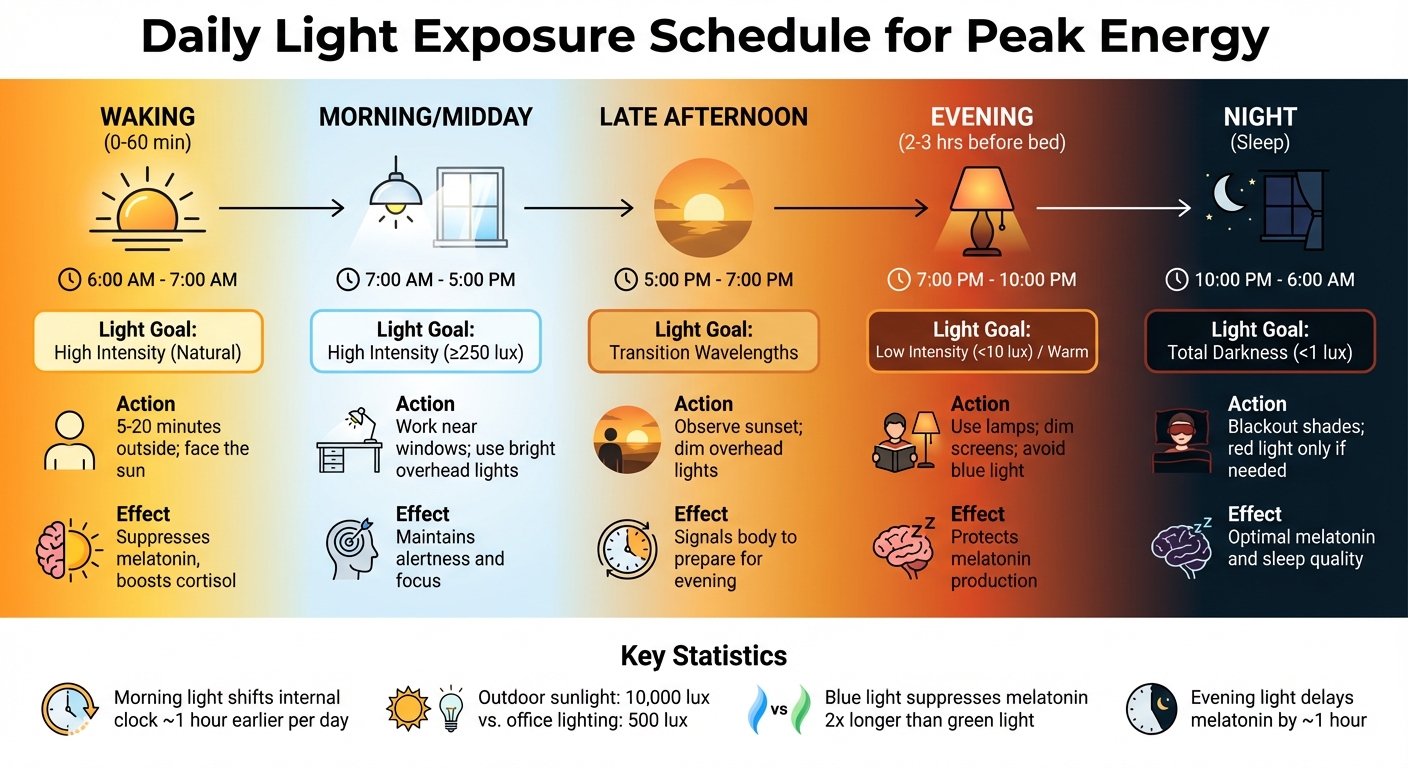
Daily Light Exposure Schedule for Optimal Energy and Sleep
Sample Daily Light Schedule
Aligning your light exposure with your natural rhythms can help optimize your energy and overall well-being. Here’s an example schedule to guide you:
Start your day by spending 5–10 minutes outside in the sunlight within the first hour of waking, or 15–20 minutes if it’s overcast. If natural light isn’t an option, use bright overhead lights to simulate morning light until the sun rises.
During work hours, try to maximize your exposure to natural light by sitting near windows or using bright overhead lighting (≥250 lux) to stay alert and focused.
In the late afternoon, take a moment to step outside and observe the low-angle sun. The yellow and orange hues signal your body that the day is winding down, helping you prepare for the evening. About 2–3 hours before bedtime, switch to dim, warm-colored lighting, such as floor lamps, and keep light levels below 10 lux. When it’s time to sleep, aim for total darkness in your room - ideally under 1 lux - to support your body’s metabolic processes.
| Time of Day | Light Goal | Practical Action |
|---|---|---|
| Waking (0–60 min) | High Intensity (Natural) | Spend 5–20 minutes outside; face the sun (don’t stare). |
| Morning/Midday | High Intensity (Overhead) | Use bright overhead lights; work near a window. |
| Late Afternoon | Transition Wavelengths | Observe the sunset or low-angle sun; dim overhead lights. |
| Evening (Pre-Sleep) | Low Intensity/Warm | Use lamps, dim screens, and avoid blue light. |
| Night (Sleep) | Total Darkness | Use blackout shades; use red light for nighttime trips. |
Adjusting the Schedule for Your Life
This sample schedule is a helpful starting point, but life rarely follows a perfect routine. You can tweak it to fit your lifestyle while sticking to the core principles. For instance, if you’re an early riser aiming to wake up even earlier, exposure to bright light within the first hour of waking can shift your internal clock about an hour earlier each day. On the other hand, night owls who prefer staying up late may benefit from bright light in the evening, though this can make early mornings tougher.
If you miss your morning light exposure, afternoon sunlight can serve as a secondary anchor for your body’s rhythm. Additionally, spending 20–30 minutes in sunlight a couple of times a week - wearing shorts and a t-shirt - can help maintain healthy hormone levels and boost your mood.
The key is consistency, not perfection. Small, steady adjustments to your light exposure can have a big impact on your daily energy. Build a routine that works for you and supports your lifestyle, and you’ll notice the difference in how you feel every day.
Supporting Energy with Supplements
Supplements That Support Your Internal Clock and Energy
While exposure to natural light is the most effective way to regulate your internal clock, certain supplements can give you an extra boost, helping to maintain steady energy levels and mental clarity throughout the day. The trick lies in knowing which nutrients align best with your body’s natural rhythms.
Take melatonin, for example. It's one of the most studied supplements for circadian health. A carefully timed 0.5 mg dose, taken about 5 hours before bedtime, paired with morning light exposure, can shift your internal clock forward by approximately 2.5 hours in just three days - without the downside of feeling groggy in the evening.
Another key player is vitamin D, especially if you spend much of your time indoors. Around 35% of American adults are deficient in this vital nutrient, which has been linked to low mood and muscle weakness. While sunlight naturally helps your body produce vitamin D, supplements can be a useful alternative during winter months or when outdoor time is limited.
Timing is crucial for other supplements, too. For instance, delaying your morning caffeine intake by 90 to 120 minutes after waking can support your body’s natural cortisol cycle and help you avoid that dreaded mid-morning energy slump.
Brands like Purelya Nature offer carefully crafted supplements designed to work alongside light exposure routines without interfering with your body’s natural signals. These strategies help stabilize your internal clock and sustain energy throughout the day.
Combining Supplements with Light Timing
To maximize the benefits of supplements, syncing their use with light exposure can further enhance your circadian rhythm. Studies show that just 30 minutes of bright morning light, coupled with an afternoon dose of melatonin, can achieve about 75% of the phase shift produced by a more time-intensive 2-hour light therapy session.
Here’s a practical way to combine these strategies: Start your day with morning light exposure during the first hour after waking - this helps stop melatonin production and naturally boosts cortisol levels. If you’re trying to shift your schedule earlier, say for an early job start or to adjust to a new time zone, you might take 0.5 mg of melatonin in the late afternoon, roughly 5 hours before your intended bedtime.
"A 30-minute morning bright-light exposure with afternoon melatonin is an efficient treatment to phase-advance human circadian rhythms." - Stephanie J. Crowley, Ph.D., Biological Rhythms Research Laboratory
Adding physical activity to your morning light routine can further reinforce your internal clock. Together, these strategies - light exposure, supplements, and exercise - create a powerful synergy to keep your energy levels stable and your focus sharp.
Whether you're addressing specific nutrient deficiencies, adjusting your schedule, or simply looking to maintain steady energy throughout the day, aligning your supplement timing with your light exposure routine can make a noticeable difference in how you feel and function.
Conclusion
By aligning your light exposure and incorporating supportive supplements, you can reinforce the daily habits outlined earlier. Getting bright light within the first hour of waking can shift your internal clock by about an hour each day, helping you feel more alert in the morning and improving your sleep at night. On the flip side, keeping evening light exposure below 10 lux at least three hours before bedtime helps preserve natural melatonin production and prevents the delays that make waking up feel so challenging.
The best part? This doesn’t require fancy gadgets or complicated routines. A few minutes of morning sunlight is enough to activate cortisol release. If you spend most of your day indoors, try sitting near a window or using bright overhead lights until mid-afternoon. This keeps dopamine and norepinephrine levels steady, which can directly enhance your focus and motivation.
Adding targeted supplements can provide an extra boost to your energy and circadian rhythm. For instance, combining a 30-minute morning light session with 0.5 mg of melatonin in the late afternoon can advance your sleep cycle by about 1.8 hours in just three days. Brands like Purelya Nature offer well-crafted formulas that support your rhythm without disrupting your body’s natural processes.
Light exposure works hand in hand with other key practices like quality sleep, regular exercise, balanced nutrition, and stress management. Together, these elements help regulate everything from hormone levels to digestion timing. By starting your day with bright light, keeping your workspace well-lit, and winding down with dim, warm lighting in the evening, you’re giving your body the signals it needs to function at its best. These small yet powerful strategies lay the groundwork for consistent, sustained energy throughout the day.
FAQs
How does exposure to morning light affect my energy and sleep quality?
Morning sunlight is a game-changer when it comes to boosting your energy and improving your sleep. By stepping outside and soaking up some natural light within the first 30–60 minutes after waking, you help align your circadian rhythm - your body’s natural clock. This simple habit not only lifts your mood and sharpens your alertness but also sets the stage for better sleep at night.
Even just 10 minutes of morning sunlight can work wonders. It helps improve focus, energy, and mental clarity. Plus, early light exposure triggers the release of dopamine and norepinephrine - key chemicals that keep you feeling energized and productive throughout the day. Making morning light a daily ritual can have a noticeable impact on how you feel, both during the day and when it’s time to wind down at night.
What are the best ways to minimize blue light exposure in the evening?
To cut down on blue light exposure in the evening, aim to limit screen time for at least 1–2 hours before bed. Blue light can interfere with your circadian rhythm, making it tougher to fall asleep. Another helpful tip is to take regular breaks from screens during the day. For instance, the 20-20-20 rule suggests looking at something 20 feet away for 20 seconds every 20 minutes, which can help ease eye strain.
You might also consider wearing blue light-blocking glasses in the evening. These can support your natural sleep-wake cycle and potentially improve sleep quality. However, for daytime use, these glasses are less effective at preventing eye strain or damage. Adjustments like dimming your device screens or using night mode can also reduce blue light intensity and make screen time easier on your eyes.
By combining these strategies - cutting back on evening screen time, taking breaks, and tweaking screen settings - you can lower your blue light exposure, promote better sleep, and support your overall well-being.
Can melatonin supplements improve the effects of light exposure on energy levels?
Melatonin supplements are widely used to help regulate sleep, particularly for challenges like jet lag or disrupted circadian rhythms. While melatonin plays a key role in signaling your body that it’s time to wind down, its connection to boosting energy through light exposure is more indirect.
Daytime exposure to bright light naturally promotes alertness and helps sync your internal clock, keeping your energy levels steady during the morning and afternoon. Melatonin, however, is typically taken in the evening to encourage restful sleep. For individuals dealing with conditions such as delayed sleep phase syndrome or shift work disorder, combining melatonin with bright light therapy can be an effective way to balance daytime energy and improve nighttime sleep.
That said, melatonin should always be used with care and under medical supervision. Taking it at the wrong time or in the wrong dose can disrupt your body’s natural rhythms. While it can complement strategies involving light exposure, melatonin’s primary purpose is to aid in sleep regulation, not to directly enhance energy during the day.